Network for Greening the Financial System (NGFS) update of their economic scenarios

Reaching net zero by 2050 could lift growth and employment but would require an inflation-boosting $160 per tonne carbon price — or equivalent “shadow price” — by the end of the decade. This will push up inflation and also raise unemployment in some countries with energy-intensive industries.

Only a relatively quick and orderly transition to a low carbon economy would add to growth while a delayed transition or no action would cut deep into the economy.If these changes occur in an orderly fashion, the scenarios suggest that it could lead to some increase in global GDP, and lower unemployment relative to prior trends.If the transition fails, the scenarios suggest that up to 13% of global GDP would be at risk by the end of the century, even before accounting for the potential consequences of severe weather events.

Currently about a fifth of the world’s greenhouse gas emissions are covered by a carbon price.

More on: https://bit.ly/3ziT7j6

EU-wide pilot exercise on banks’ climate risk by EU Banking Authority

The EU aggregated GAR stands at 7.9%, which identifies the institutions’ assets financing activities that are environmentally sustainable according to the EU taxonomy.

More disclosure on transition strategies and GHG emissions would be needed to allow banks and supervisors to assess climate risk more accurately. It is important banks to expand their data infrastructure to include clients’ information at activity level.

Regarding the EU taxonomy classification, banks are currently in different development phases to assess the greenness of their exposures. The two estimation techniques, banks’ bottom-up estimates and a top-down tool, are considered in the exercise and the report highlights the differences in outcomes.

The scenario analysis shows that the impact of climate-related risks across banks has different magnitudes and is concentrated in some particular sectors. The findings should be considered as starting point estimates for future work on climate risk.

More on: https://bit.ly/3ufO53o

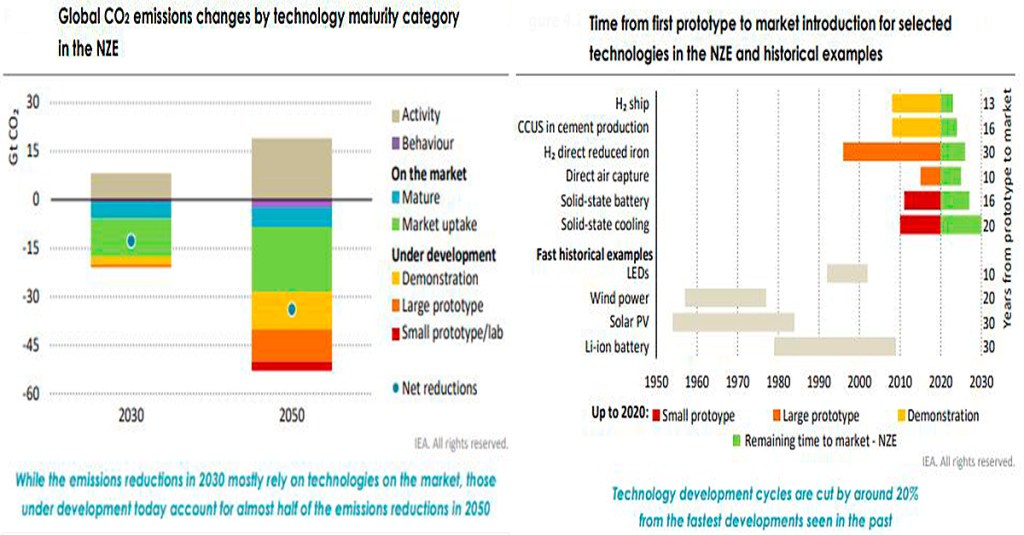
Innovation is key for the Net‐Zero Emissions Scenario 2050 (NZE)

The @IEA just released the world’s first comprehensive roadmap for the global energy sector to reach net-zero emissions by 2050. They say almost 50% of the emissions reductions needed in 2050 in the NZE depend on technologies that are at the prototype or demonstration stage. This share is even higher in sectors such as heavy industry and long‐distance transport.
This is clearly ambitious, as most clean energy technologies that have not been demonstrated at scale today should reach markets by 2030 at the latest. Technologies at the demonstration stage, such as CCUS in cement production or low‐emissions ammonia‐fuelled ships, are brought into the market in the next three to four years. Hydrogen‐based steel production, direct air capture (DAC) and other technologies at the large prototype stage reach the market in about six years, while most technologies at small prototype stage – such as solid state refrigerant‐free cooling or solid state batteries – do so within the coming nine years.
In the NZE, electrification, CCUS, hydrogen and sustainable bioenergy account for nearly half of the cumulative emissions reductions to 2050. Just three technologies are critical in enabling around 15% of the cumulative emissions reductions in the NZE between 2030 and 2050: advanced high‐energy density batteries, hydrogen electrolysers and DAC.

You can read the report “Net Zero by 2050: A Roadmap for the Global Energy Sector” here

“ESG rating disagreements” – new research paper

Rating agencies disagree substantially about how they assess individual firms. Without agreement on what constitutes good ESG performance, market participants can be misled by these ratings.

The authors of this paper found ESG disagreement is most pronounced for firms with high levels of ESG disclosure, contrary to the argument that disclosure reduces disagreement. While thousands of companies now claim to integrate ESG issues in their business strategy and operations, it is not clear whether those claims are merely cheap talk.

Ratings could help investors and other stakeholders to choose companies that exhibit their preferred ESG outcomes. Having rating agencies focus on ESG outcomes could motivate companies to show real outcomes in their disclosures rather than highlighting the adoption of policies or initiatives that might not generate any real effects.

Lot of work still needs to be done to develop rules and norms that determine what characterises good ESG performance.

Authors of the research paper:

Dane Christensen, @GeorgeSerafeim, @AnywhereSikochi . More on https://bit.ly/3ooKChi

Citation:

Christensen, Dane M. and Serafeim, George and Sikochi, Anywhere, Why is Corporate Virtue in the Eye of the Beholder? The Case of ESG Ratings (February 26, 2021). The Accounting Review. DOI: 10.2308/TAR-2019-0506