The New Cold War is Digital – and it’s Already Reshaping Global Power

From artificial intelligence to quantum tech, we’re witnessing a seismic shift in how countries define influence and sovereignty. This isn’t just about innovation anymore — it’s about values, governance, and global positioning.

As someone deeply interested in tech policy and diplomacy, I’ve been reflecting on how major powers are approaching this transformation. Here’s a high-level look at how governments are navigating this new digital landscape:

Key Global Approaches to Tech Governance

  • EU: Leading the way with the AI Act — a bold, risk-based framework grounded in ethics and digital rights.
  • US: Prioritizing innovation with executive orders and a $1.7T bioeconomy push — focused on resilience, competition, and security.
  • China: Driving state-led initiatives like Made in China 2025 and massive quantum R&D for tech sovereignty.
  • UK: Taking a flexible, pro-innovation stance while fostering transatlantic cooperation.

Strategic Tech Domains to Watch:

  • AI Governance: From the EU’s regulatory leadership to China’s national security-driven controls, the race to shape AI norms is on.
  • Cybersecurity & Digital Sovereignty: NIS2 in the EU, new US cyber strategy, and China’s walled cyberspace — all aiming to secure digital autonomy.
  • Biotech & Biosafety: With the US and EU aligning bio-innovation to health and sustainability, we’re seeing biotech become a strategic pillar, not just a science issue.
  • Quantum Tech: Quantum is no longer future talk — the US, EU, and China are investing billions in what could be tomorrow’s defining tech advantage.

Multilateral Moves that Matter:

  • EU–US Trade and Tech Council (TTC) is shaping AI and semiconductor coordination.
  • UNESCO, OECD, G7: Working on global ethical frameworks.
  • Digital Partnerships (EU–Japan, UK–Singapore, etc.) show a real appetite for trusted, cross-border digital cooperation.

What’s the Common Thread?

Despite differences in approach, there’s a shared recognition that the future must be built on:

  • Ethical AI
  • Sustainable innovation
  • Strategic investment
  • Digital rights and accountability

A call to Action:

We need governance models that are collaborative, values-driven, and future-proof. The digital world is too important to be left to chance or rivalry alone.

Let’s build a digital future that supports democracy, development, and dignity!.

Curious to hear your thoughts: How do you see your country, company, or community navigating this new era?

Why 90% of Companies Fail at Digital Transformation (And How Modular Architecture + AI Fixes It)

Here’s a hard truth: Most enterprise architectures are built like medieval castles—impressive, rigid, and completely useless when the world changes overnight.

The $900 Billion Problem No One Talks About

While executives throw billions at “digital transformation,” they’re missing the fundamental issue. It’s not about having the latest tech stack or hiring more developers.

It’s about architecture.

Think about it: You wouldn’t build a house without blueprints, yet companies are running multi-billion dollar operations on architectural chaos. The result? They can’t adapt fast enough when markets shift, competitors emerge, or customer needs evolve.

The Four Pillars That Make or Break Your Business

Every successful enterprise runs on four architectural foundations. Get one wrong, and your entire digital strategy crumbles:

1. Business Architecture: Your Money-Making Blueprint

This isn’t corporate fluff—it’s how you actually create value. Your business models, processes, capabilities, and strategies either work together like a Swiss watch, or they’re fighting each other like a dysfunctional family.

Red flag: If you can’t explain how your business creates value in one sentence, your architecture is broken.

2. Data Architecture: Your Digital Nervous System

Data is the new oil, but most companies are drilling with stone-age tools. Your data models, flows, and APIs should work seamlessly together, not require a PhD to understand.

Reality check: If finding the right data takes your team hours instead of seconds, you’re bleeding money.

3. Application Architecture: Your Digital Muscles

Your applications should be lean, mean, and modular. Instead, most companies have Frankenstein systems held together with digital duct tape.

Warning sign: If adding a simple feature requires touching 15 different systems, you’re in trouble.

4. Technology Architecture: Your Foundation

This is your infrastructure, networks, and security. It should be invisible when it works and obvious when it doesn’t.

The test: Can you scale up 10x without your systems catching fire? If not, you’re not ready for growth.

The Million-Dollar Dilemma Every CEO Faces

Here’s where it gets real: Every business faces the same impossible choice—perform today or transform for tomorrow.

  • Focus on core business = make money now, but risk becoming irrelevant
  • Focus on transformation = maybe make money later, but struggle today

Most companies choose wrong. They either become innovation-paralyzed cash cows or transformation-obsessed startups that never turn a profit.

The Game-Changing Solution: Modular Architecture

Smart companies have figured out the cheat code: modularity.

Instead of choosing between today and tomorrow, modular architecture lets you do both. Here’s why it’s pure genius:

Adapt in days, not years when markets shift
Scale individual components without rebuilding everything
Test new ideas without risking core operations
Pivot instantly when opportunities emerge

Real talk: Companies with modular architecture adapt 3x faster than their competitors. While others are still having meetings about change, modular companies are already capturing new markets.

Where AI Becomes Your Secret Weapon

Here’s where it gets exciting. AI isn’t just another tool—it’s the ultimate architecture amplifier. But only if you use it right.

At the Business Level: AI predicts market shifts, mines hidden process insights, and simulates business models before you risk real money.

At the Data Level: AI automatically cleans your data mess, detects anomalies you’d never catch, and creates synthetic data for testing without privacy nightmares.

At the Application Level: AI monitors your systems 24/7, generates code that actually works, creates self-healing applications, and automates testing that would take humans months.

At the Technology Level: AI manages your cloud infrastructure, fights cyber threats in real-time, and optimizes everything automatically.

The Bottom Line (And Why This Matters Right Now)

The companies winning today aren’t the ones with the biggest budgets—they’re the ones with the smartest architecture.

While your competitors are stuck in architectural quicksand, modular architecture + AI gives you superpowers:

  • React to market changes in real-time
  • Launch new products at lightning speed
  • Scale without breaking everything
  • Innovate without sacrificing stability

Your Next Move

The brutal reality: Every day you delay building modular architecture is another day your competitors get further ahead.

The companies that embrace this approach won’t just survive the next market disruption—they’ll be the ones causing it.

The question isn’t whether you should build modular architecture enhanced by AI.

The question is: Can you afford not to?


What’s your biggest architectural challenge right now? Share in the comments.

Strategy to Capitalize on Generative AI in Business

Featured

The integration of Generative AI (GenAI) in businesses presents both challenges and opportunities. This article outlines strategies for deploying GenAI, ensuring compliance, managing risks, and facilitating monetization in a rapidly evolving technological environment.

A.- Understanding GenAI Challenges

Key obstacles to GenAI integration include:

  • Lack of incentives: Without apparent benefits, employees might resist new AI tools.
  • Ignorance of AI’s potential: Misunderstanding what AI can do often leads to its underuse.
  • Fear of job displacement: Concerns about AI replacing jobs or empowering junior employees can cause resistance.
  • Restrictive policies: Conservative approaches may stifle AI adoption, pushing employees to seek alternatives outside the organization.

B.- Strategic Integration of GenAI

  • Identify High-Value Applications: Target roles and processes where GenAI can boost efficiency, such as data analysis and customer service, ensuring immediate impact and wider acceptance.
  • Educate and Incentivize Employees: Develop training programs coupled with incentives to foster AI adoption and proficiency.
  • Risks and Contingency Planning: Assess and manage technological, regulatory, and organizational risks with proactive safeguards and strategic planning for potential issues.
  • Incremental Implementation: Start with pilot projects offering high returns, which can be expanded later, showcasing their effectiveness and ROI.

C.- Monetization Strategies

  • Enhance Productivity: Apply GenAI to automate routine tasks and enhance complex decision-making, freeing up resources for more strategic tasks, thereby reducing costs and improving output quality.
  • Develop New Products and Services: Utilize GenAI to create innovative products or enhance existing ones, opening up new revenue streams like AI-driven analytics services.
  • Improve Customer Engagement: Deploy GenAI tools like chatbots or personalized recommendation systems to boost customer interaction and satisfaction, potentially increasing retention and sales.
  • Optimize Resource Management: Use GenAI to predict demand trends, optimize supply chains, and manage resources efficiently, reducing waste and lowering operational costs.

D.- Conclusion

Successfully integrating and monetizing GenAI involves overcoming resistance, managing risks, and strategically deploying AI to boost productivity, drive innovation, and enhance customer engagement. By thoughtfully addressing these issues, companies can thrive in the era of rapid AI evolution.

The EU AI Act: An Overview

Featured

Set to take effect in stages starting summer 2024, the AI Act is poised to become the world’s first comprehensive AI law. It aims to govern the use and impact of AI technologies across the EU, affecting a broad range of stakeholders including AI providers, deployers, importers, and distributors.
🔹𝐊𝐞𝐲 𝐏𝐫𝐨𝐯𝐢𝐬𝐢𝐨𝐧𝐬 & 𝐈𝐦𝐩𝐚𝐜𝐭: The Act categorizes AI systems into prohibited, high-risk, and general-purpose models, each with specific compliance requirements. Notably, high-risk AI systems face stringent obligations, impacting sectors from employment to public services. The Act also introduces bans on certain AI practices deemed harmful, like emotion recognition in workplaces or untargeted image scraping for facial recognition.
🔹𝐂𝐨𝐦𝐩𝐥𝐢𝐚𝐧𝐜𝐞 & 𝐏𝐞𝐧𝐚𝐥𝐭𝐢𝐞𝐬: Compliance will vary by the nature of AI usage with penalties for non-compliance reaching up to €35 million or 7% of annual worldwide turnover. The AI Act also incorporates and aligns with existing EU regulations like GDPR, requiring businesses to assess both new and existing legal frameworks.
🔹𝐓𝐢𝐦𝐞𝐥𝐢𝐧𝐞 𝐟𝐨𝐫 𝐈𝐦𝐩𝐥𝐞𝐦𝐞𝐧𝐭𝐚𝐭𝐢𝐨𝐧: The AI Act will phase in its provisions, with most obligations impacting businesses after a two-year period post-law enactment.
🔹𝐒𝐭𝐫𝐚𝐭𝐞𝐠𝐢𝐜 𝐂𝐨𝐧𝐬𝐢𝐝𝐞𝐫𝐚𝐭𝐢𝐨𝐧𝐬: Entities involved in AI need to develop robust governance frameworks early to align with the Act’s requirements. As AI technologies and legal standards evolve, staying informed and adaptable is crucial.
🔹𝐆𝐥𝐨𝐛𝐚𝐥 𝐏𝐞𝐫𝐬𝐩𝐞𝐜𝐭𝐢𝐯𝐞: Unlike the EU’s comprehensive approach, the UK is currently opting for a non-binding, principles-based framework for AI regulation. This divergence highlights varying international stances on AI governance.
For businesses and professionals involved in AI, the incoming AI Act represents both a challenge and an opportunity to lead in responsible AI deployment and innovation.

More on: https://bit.ly/4bN8gM0

𝐹𝑜𝑙𝑙𝑜𝑤 𝑚𝑒 𝑜𝑛 𝑋: @𝑀𝑖𝑔𝑢𝑒𝑙𝐶ℎ𝑎𝑚𝑜𝑐ℎ𝑖𝑛

EU Sets Global Precedent with Comprehensive AI Act

Featured

The European Union has just reached a landmark agreement on a comprehensive AI law, poised to set a global precedent. This new regulation, known as the AI Act, is one of the first of its kind and aims to manage the rapidly evolving AI technology with a risk-based approach.

Key highlights of the AI Act include:

  • Risk-Based Regulation: The AI Act will categorize AI systems based on their level of risk, with the most stringent regulations applied to high-risk models. This includes popular large AI models like ChatGPT.
  • Enforcement Across EU: All 27 member states will be involved in enforcing the law, with certain aspects taking up to 24 months to become effective.
  • Global Impact: The legislation is expected to influence AI development worldwide, serving as a model for other countries.
  • Comprehensive Prohibitions: The AI Act will ban AI use for social scoring, manipulating human behavior, and exploiting vulnerable groups. Strict restrictions are also placed on facial recognition technology and AI systems in the workplace and educational institutions.
  • Significant Fines for Non-Compliance: Companies that fail to comply with these new rules could face fines of up to €35 million or 7% of global revenue.
  • Two-Tier Approach for AI Models: The Act establishes transparency requirements for general-purpose AI models and stronger requirements for those with systemic impacts.
  • Encouragement for Innovation: Despite strict regulations, the Act aims to avoid excessive burdens on companies, promoting a balance between safeguarding AI technology use and encouraging innovation.
  • Future Perspectives: Looking ahead, this legislation is a crucial step in shaping the global AI regulatory landscape, with implications for AI legislation and automated decision-making rules in other jurisdictions, including Canada, the United States, and beyond.

The EU AI Act is much more than just a set of rules; it’s a catalyst for EU startups and researchers to lead in the global AI race. With this act, the EU becomes the first continent to establish clear rules for AI use, potentially guiding future global standards in AI regulation.

More on: https://bit.ly/486f0n3

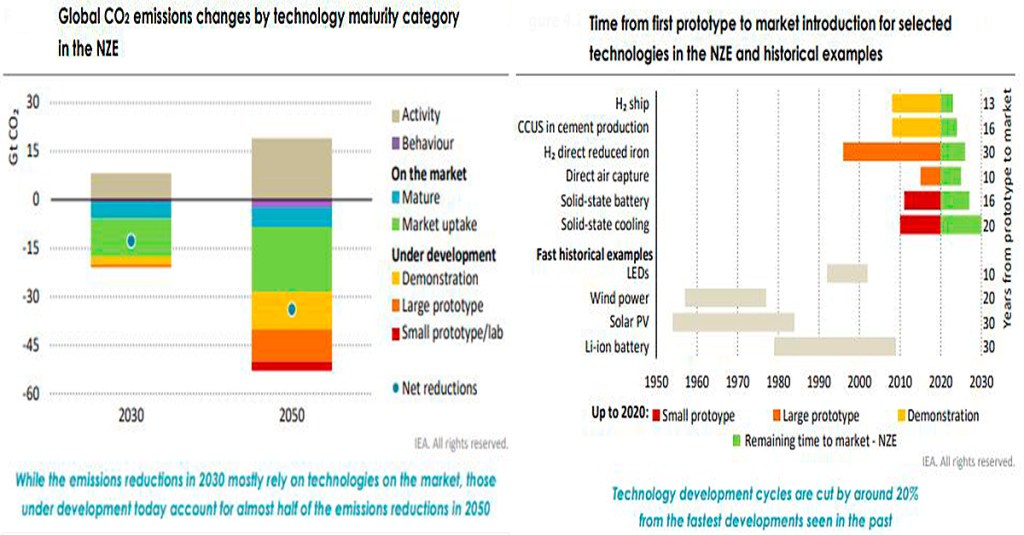
Innovation is key for the Net‐Zero Emissions Scenario 2050 (NZE)

The @IEA just released the world’s first comprehensive roadmap for the global energy sector to reach net-zero emissions by 2050. They say almost 50% of the emissions reductions needed in 2050 in the NZE depend on technologies that are at the prototype or demonstration stage. This share is even higher in sectors such as heavy industry and long‐distance transport.
This is clearly ambitious, as most clean energy technologies that have not been demonstrated at scale today should reach markets by 2030 at the latest. Technologies at the demonstration stage, such as CCUS in cement production or low‐emissions ammonia‐fuelled ships, are brought into the market in the next three to four years. Hydrogen‐based steel production, direct air capture (DAC) and other technologies at the large prototype stage reach the market in about six years, while most technologies at small prototype stage – such as solid state refrigerant‐free cooling or solid state batteries – do so within the coming nine years.
In the NZE, electrification, CCUS, hydrogen and sustainable bioenergy account for nearly half of the cumulative emissions reductions to 2050. Just three technologies are critical in enabling around 15% of the cumulative emissions reductions in the NZE between 2030 and 2050: advanced high‐energy density batteries, hydrogen electrolysers and DAC.

You can read the report “Net Zero by 2050: A Roadmap for the Global Energy Sector” here